
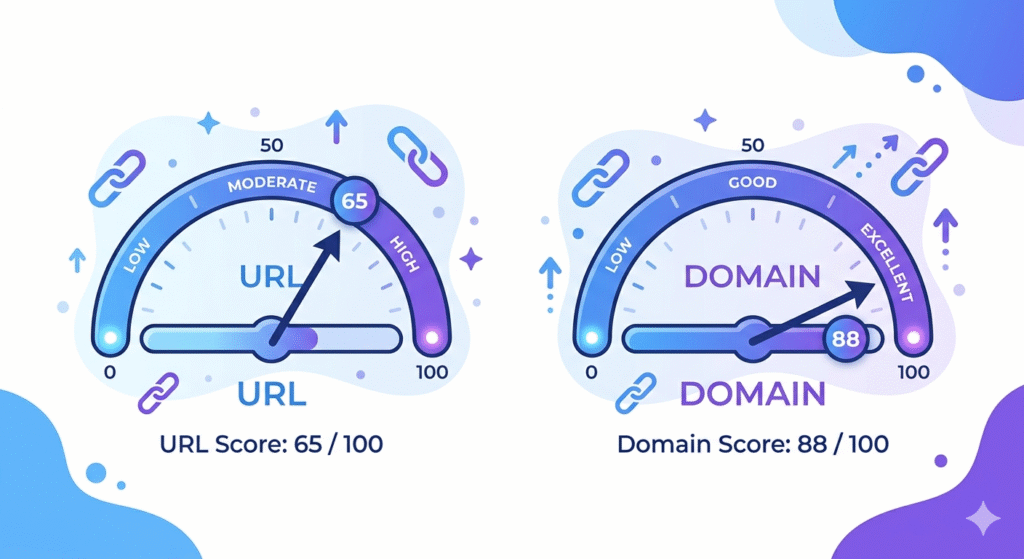
Most people who use Ahrefs focus on Domain Rating and ignore URL Rating completely. That is a big mistake. URL Rating is actually one of the most useful metrics for understanding why specific pages rank on Google, and why others do not, even on the same website. In this guide we will explain exactly what URL Rating is, how it is calculated, what a good score looks like, and how you can use it to improve your SEO results page by page.
What is URL Rating?
URL Rating, commonly written as UR, is a metric developed by Ahrefs. It measures the backlink strength of a single specific page on a scale from 0 to 100. The higher the score, the stronger that individual page is considered to be based on the links pointing directly to it.
The key word here is page. URL Rating does not look at your entire website. It only looks at one URL at a time. This makes it different from Domain Rating, which measures the authority of your whole domain.
For example, your homepage might have a UR of 25, but a blog post that got shared widely and earned several backlinks could have a UR of 40. Both pages sit on the same domain, but their individual page strength is completely different.
How is URL Rating Calculated?
Ahrefs calculates URL Rating based on two main things:
1. How many backlinks point to that specific page The more links pointing directly to a URL, the higher its UR tends to be. But quantity alone is not enough.
2. The quality and UR of the pages linking to it A link from a page with UR 60 passes far more value than a link from a page with UR 5. So the strength of the pages linking to you matters just as much as how many there are.
There is also an internal link factor. When pages within your own website link to a specific page, some authority flows through those internal links too. This is why internal linking is so important, it helps distribute UR across your site.
Like Domain Rating, URL Rating uses a logarithmic scale. This means going from UR 10 to UR 20 is much easier than going from UR 50 to UR 60. The higher you go, the harder it gets. Learn how to use internal links properly in our guide on Step by Step Link Building Strategy
URL Rating vs Domain Rating, The Core Difference
This is where most beginners get confused. Here is the simplest way to think about it:
- Domain Rating is the authority score of your entire website. We have a full beginner guide on What is Domain Rating and Why Does It Matter if you want to go deeper
- URL Rating is the authority score of one specific page
A website can have a high DR but individual pages with low UR if those pages have not earned many direct backlinks. Similarly, a single page on a low DR website can have a surprisingly high UR if many strong pages have linked directly to it.
This is actually why some pages from newer or smaller websites manage to outrank pages from bigger, more established sites. Their individual page strength, the UR, is higher even if their overall domain authority is lower.
Why Does URL Rating Matter for SEO?
URL Rating matters because Google ranks individual pages, not entire websites. When someone searches for a keyword, Google is deciding which specific page deserves to rank, not which website is generally the best. This makes page level authority extremely important.
Here is why UR should be on your radar:
It helps you understand ranking potential Before targeting a keyword, check the UR of the pages currently ranking for it. If the top results all have UR 40 and above, you know you need strong backlinks pointing to your specific page to compete. If some results have UR 10 to 20, you have a real opportunity.
It shows you which pages need more backlinks If a page on your site is ranking on page 2 with a UR of 8, adding a few quality backlinks directly to that page could push it to page 1. UR gives you a precise target to work towards.
It helps you prioritize your link building Instead of building all your backlinks to your homepage, you can identify which blog posts or service pages need the most link support and direct your efforts there.
It reveals internal linking opportunities Pages on your site with high UR can pass authority to lower UR pages through internal links. Identifying your strongest pages and linking from them to your weaker pages is a free and highly effective SEO tactic.
What is a Good URL Rating Score?
Just like Domain Rating, what counts as a good UR depends entirely on what you are competing against. Here is a general guide:
- UR 0 to 10: New or rarely linked page. Normal for fresh content with no backlinks yet.
- UR 11 to 25: Growing page with some backlinks. Can compete for low competition keywords.
- UR 26 to 40: Decent page authority. Competitive in most moderate niches.
- UR 41 to 60: Strong page. You can compete for most medium to high competition keywords.
- UR 61 to 100: Very high authority. Think Wikipedia articles, major news pages, and industry leading resources.
For a new website, most pages will start at UR 0 to 5. That is completely normal. The goal is to gradually increase UR on your most important pages through targeted link building and smart internal linking.
How to Check URL Rating
Checking UR is simple if you use Ahrefs. Here are the main ways:
Ahrefs Site Explorer Enter any URL into Site Explorer and you will see the UR score right at the top alongside other key metrics. You can also see which pages on your site have the highest UR by going to the Top Pages report.
Ahrefs SEO Toolbar This is a free browser extension from Ahrefs. When you visit any webpage, the toolbar shows you the UR and DR of that page instantly without needing to open Site Explorer. This is especially useful when doing keyword research and checking competitor pages directly in Google search results.
Ahrefs Keywords Explorer When you look up a keyword, the SERP overview shows the UR of every page currently ranking for that term. This is one of the most useful ways to use UR because it tells you exactly how strong your competition is at the page level.
How to Improve Your URL Rating
Improving UR comes down to getting more quality backlinks pointing to that specific page. Here are the most effective ways to do it:
Build backlinks directly to your important pages Do not just build links to your homepage. When doing guest posts or outreach, ask for links to your most important blog posts or service pages. A backlink pointing to a specific page boosts that page’s UR directly.
Use internal links from your high UR pages Find the pages on your site with the highest UR using Ahrefs Top Pages report. Then add internal links from those pages to the ones you want to boost. This passes authority through your own site for free.
Create content that naturally earns links Detailed guides, original research, comparison posts, and data-driven articles attract backlinks naturally. When people link to your content, they almost always link to the specific page they found useful, which builds UR directly on that page.
Update and improve existing content Refreshing older content with new information, better formatting, and more depth makes it more link worthy. Updated content also gets recrawled by Google faster, which means any new backlinks get recognized more quickly.
Promote your content after publishing Share new blogs on social media, in relevant communities, and through email outreach. More visibility leads to more natural backlinks, which directly improves UR over time.
A Common Mistake to Avoid
Many website owners build all their backlinks to their homepage and then wonder why their individual blog posts and service pages are not ranking. Your homepage DR goes up but your page level UR stays low, and since Google ranks pages not domains, your content struggles to compete.
The fix is simple. Spread your link building across your most important pages. Give Google strong signals at the page level, not just the domain level. If you are building links on a budget, check out How to Build Backlinks Without Spending Money.
Frequently Asked Questions
Is URL Rating the same as Page Authority? They are similar concepts but different metrics. URL Rating is from Ahrefs while Page Authority is from Moz. Both measure page level backlink strength but use different calculations. If you use Ahrefs, focus on UR.
Can a page have a higher UR than the site’s DR? Yes, this is possible in rare cases where a single page has attracted an unusually high number of strong backlinks compared to the rest of the site.
Does URL Rating directly affect Google rankings? UR is an Ahrefs metric, not a Google metric. However, the backlinks that improve your UR are the same backlinks that help Google understand your page’s authority. So while UR itself is not a ranking factor, it closely reflects the signals that are.
How often does Ahrefs update URL Rating? Ahrefs updates UR regularly, typically every few days for actively crawled sites.
My UR is 0 but my page is indexed. Is that normal? Completely normal. A UR of 0 just means Ahrefs has not detected any backlinks pointing to that specific page yet. As you build links or earn them naturally, UR will start to climb.
Does deleting pages affect URL Rating on other pages? If you delete a page that had backlinks, those links lose their destination and the UR value they were passing disappears. Always redirect deleted pages to relevant alternatives to preserve link value.
Conclusion
URL Rating is one of the most underused metrics in SEO, yet it is one of the most directly connected to ranking performance. Because Google ranks individual pages, understanding and improving your page level authority is just as important as building your overall domain strength.
Start by checking the UR of your most important pages in Ahrefs. Identify which ones are close to page one rankings and build a few targeted backlinks directly to those pages. Combine that with smart internal linking and you will start seeing real ranking movement faster than you expect. Ready to start earning quality backlinks? Here is our Step by Step Link Building Strategy to follow from day one.
Need help building quality backlinks to boost your page authority? Check our Link Building Packages and get started today.