
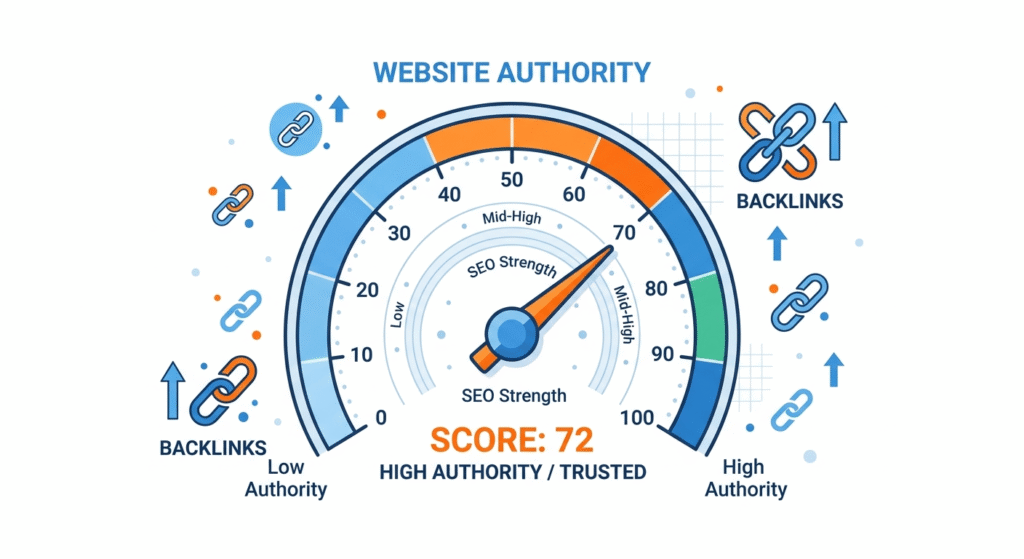
If you have ever used Ahrefs or read anything about SEO, you have probably come across the term Domain Rating. It sounds technical, but it is actually a simple concept once you break it down. In this guide, we will explain exactly what Domain Rating is, how it is calculated, why it matters for your website, and what you should realistically aim for as a beginner.
What is Domain Rating?
Domain Rating, often shortened to DR, is a metric created by Ahrefs. It measures the strength of a website’s backlink profile on a scale from 0 to 100. The higher the number, the stronger and more authoritative the website is considered to be in terms of the backlinks pointing to it.
Think of it like a reputation score. If lots of trusted and well-known websites are linking to your site, your Domain Rating goes up. If very few sites link to you, or the ones that do are low quality, your DR stays low.
It is important to understand that Domain Rating is an Ahrefs-specific metric. It is not a Google ranking factor directly, but it is widely used in the SEO industry as a quick way to measure a site’s overall link authority.
How is Domain Rating Calculated?
Ahrefs calculates Domain Rating based on three main things:
1. How many unique websites link to you The more referring domains you have, the better. One link from 50 different websites is far more valuable than 50 links from the same website.
2. The DR of those linking websites A link from a website with DR 70 carries much more weight than a link from a website with DR 5. So the quality of your backlinks matters as much as the quantity.
3. How many outgoing links those websites have If a website links to thousands of other sites, each individual link from that site carries less weight. A link from a focused, niche site is generally worth more.
The scale is also logarithmic, meaning it gets harder to move up as you go higher. Going from DR 0 to DR 20 is much easier than going from DR 60 to DR 70.
What is a Good Domain Rating?
This is one of the most common questions beginners ask, and the honest answer is, it depends on your niche and who you are competing with.
Here is a general guide:
- DR 0 to 10: Brand new or very early stage website. Completely normal when starting out.
- DR 11 to 30: Growing site with some backlinks. You can start competing for low competition keywords.
- DR 31 to 50: Decent authority. You can compete in most moderate niches.
- DR 51 to 70: Strong site. You are competitive in most industries.
- DR 71 to 100: High authority. Think major news sites, Wikipedia, and industry leaders.
For a new website like linknestor.com, being at DR 2 right now is perfectly normal. The goal in the first year should be to reach DR 20 to 30 by consistently earning quality backlinks.
Why Does Domain Rating Matter?
DR matters for a few key reasons:
It helps you understand your competition Before targeting a keyword, you can check the DR of websites already ranking for it. If all the top results are DR 70 and above, you know it will be hard to compete right now. If some results are DR 20 to 30, you have a real shot.
It helps you evaluate backlink opportunities When someone offers to link to you, checking their DR quickly tells you how valuable that link might be. A link from a DR 40 site is generally more valuable than one from a DR 5 site.
It tracks your link building progress As you build backlinks over time, your DR should gradually increase. It is a useful way to measure whether your link building efforts are actually working.
It builds trust with potential partners When you reach out for guest posts or link exchanges, other website owners will often check your DR. A higher DR makes you a more attractive partner.
Domain Rating vs Domain Authority, What is the Difference?
You may have also heard of Domain Authority, or DA, which is a similar metric created by Moz. Both measure the strength of a website’s backlink profile, but they are calculated differently and come from different tools.
Neither one is better or worse overall. The key point is that they are both third-party metrics, not official Google scores. Google does not use DR or DA when ranking your website. However, both metrics do a reasonable job of reflecting how well a site is likely to perform based on its backlinks.
If you use Ahrefs, focus on DR. If you use Moz, focus on DA. Do not try to compare them directly as the numbers will rarely match.
How to Improve Your Domain Rating
The only real way to improve your DR is to earn more high-quality backlinks from websites that already have a decent DR themselves. Here are the most practical ways to do that as a beginner:
Write content worth linking to Detailed guides, original data, comparisons, and how-to articles naturally attract backlinks when people find them useful. Avoid these Common Backlink Mistakes while building your strategy
Guest posting Write articles for other blogs in your niche and include a link back to your site. This is one of the most reliable ways to build DR early on.
Get listed in niche directories Find reputable directories in your industry and submit your site. These links are not the strongest, but they help when you are starting from zero.
Use HARO and similar platforms Respond to journalist queries in your niche. When your response gets published, you often earn a link from a high DR news or media site. Read our full guide on Using HARO for Backlinks.
Broken link building Find broken links on other websites in your niche, then suggest your own content as a replacement. It is a win for them and a backlink for you.
Common Misconceptions About Domain Rating
“A high DR means you will rank on Google” Not necessarily. DR measures backlink strength, not content quality or relevance. You still need great content and proper on-page SEO to rank well.
“DR 50 is the goal for everyone” Not true. In many low-competition niches, a DR of 20 to 30 is more than enough to rank on page one. Always compare your DR to your actual competitors, not to random benchmarks.
“DR never goes down” It can go down if websites that link to you lose their own authority, remove your link, or shut down. Monitoring your backlinks regularly is important.
Frequently Asked Questions
How often does Ahrefs update Domain Rating? Ahrefs updates DR regularly, typically every few days for most sites.
Can I have a high DR with very few backlinks? It is possible if the few backlinks you have come from very high DR websites. Quality matters more than quantity.
Is DR 2 bad for a new website? Not at all. Almost every website starts at DR 0 or DR 1. A DR of 2 with consistent content and link building efforts will grow steadily over time.
Does Domain Rating affect my Google rankings directly? No. DR is an Ahrefs metric, not a Google metric. However, the backlinks that improve your DR often also help your Google rankings indirectly.
How long does it take to increase Domain Rating? It varies. With consistent link building, most new sites can reach DR 20 in 6 to 12 months.
Conclusion
Domain Rating is one of the most useful metrics for understanding where your website stands in terms of backlink authority. It is not a perfect measure and it is not a Google ranking factor on its own, but it gives you a clear picture of your link building progress and helps you make smarter SEO decisions.
If you are just starting out, do not worry about your DR being low. Focus on creating helpful content, earning quality backlinks one at a time, and your DR will grow naturally alongside your site.